


Short answer
Choose VRV/VRF when a building has many zones with different operating hours and moderate loads, as in bank branches and most offices. Choose a chilled-water plant when loads are large and continuous, or when fresh air, filtration and humidity need tight central control, as in hospitals. Many buildings combine both systems.
How the two systems work
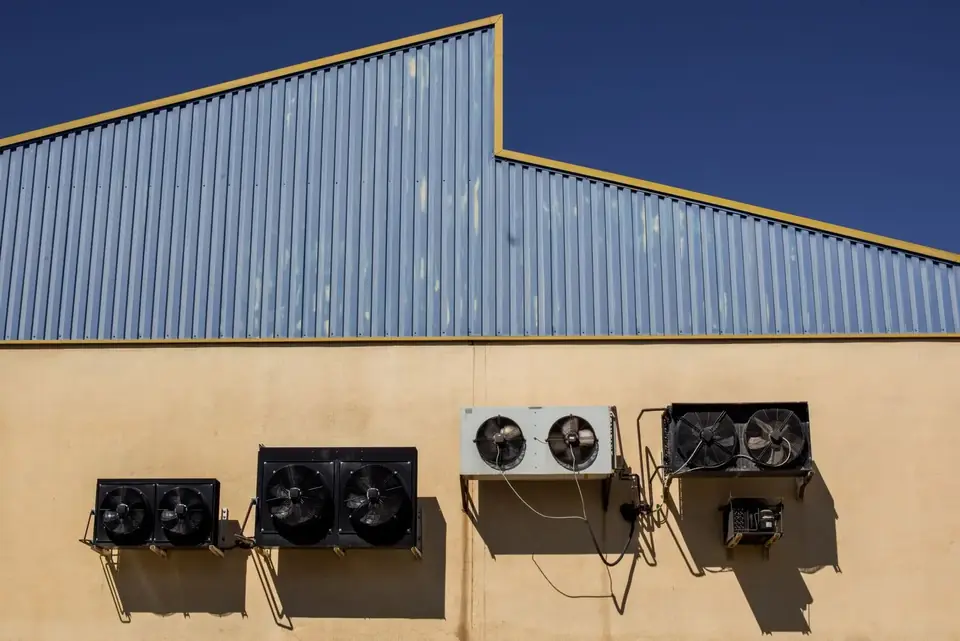
A VRV/VRF system (variable refrigerant volume or flow; VRV is Daikin’s trade name) circulates refrigerant from outdoor condensing units through copper pipework to indoor units in each room or zone. Inverter compressors vary their output to match the load, so the system runs efficiently at part load, and each zone can be controlled on its own. Heat-recovery versions can cool some zones while heating others.
A chilled-water system produces cold water in a central chiller plant, either air-cooled or water-cooled with cooling towers, and pumps it to air handling units (AHUs) and fan coil units (FCUs). Air is treated in the AHU, where fresh air, filtration and humidity can be controlled closely before the air is ducted to the spaces.
Side-by-side comparison
| Criterion | VRV/VRF | Chilled water (chillers) |
|---|---|---|
| Best fit | Small and medium buildings with many zones | Large buildings and campuses with high, continuous loads |
| Zoning and individual control | Excellent: each indoor unit is controlled separately | Good, through AHU and FCU controls and a BMS |
| Fresh air, filtration, humidity | Needs a separate fresh-air or dedicated outdoor-air unit | Handled centrally in AHUs; suits strict requirements |
| Plant space | Outdoor units on the roof or a terrace; no chiller plant room | Chiller plant and pumps, plus cooling towers if water-cooled |
| Refrigerant in occupied spaces | Yes; check refrigerant concentration limits for small rooms | No; only water runs through occupied areas |
| Phased installation | Systems can be added floor by floor | The central plant is usually sized and built up front |
| Redundancy | Several independent systems; one failure affects one group of zones | Designed with standby chillers and pumps |
| Maintenance skills | Refrigerant, inverter and controls specialists | Plant operation, water treatment and mechanical maintenance |
Neither option is cheaper in every case. Capital cost, running cost and life-cycle cost depend on the load profile, operating hours, electricity tariff, equipment selection and the quality of maintenance, so compare complete options for your building rather than rules of thumb.

Hospitals: control first, then efficiency
Hospitals combine areas with very different needs. Operating theatres, intensive care units, isolation rooms and some laboratories depend on controlled air change rates, filtration and pressure relationships between rooms, which are usually delivered by dedicated AHUs. These requirements come from healthcare ventilation standards and from the specifications of the health authority or hospital operator, and the designer should fix them before any equipment is chosen.
For large hospitals this usually points to a chilled-water plant feeding AHUs, with standby capacity so that cooling never depends on a single machine. Smaller hospitals, clinics and administrative wings often use VRV/VRF for patient rooms and offices, combined with dedicated AHUs for the critical areas.
Bank branches and offices: zoning and phasing
A bank branch typically has a banking hall, offices, a server or UPS room and a strongroom, each with different hours of use. VRV/VRF suits this well: compact outdoor units, individual control and no plant room. Server and UPS rooms should have their own dedicated or close-control cooling with redundancy, instead of relying on the comfort system.
For offices, the decision depends on size and tenancy. Multi-tenant buildings and floors fitted out in phases favour VRV/VRF, because each tenant or floor can have its own system and metering. Large single-occupier headquarters with long operating hours often justify a chilled-water plant, especially when a building management system is used to optimise it.
Questions to settle before you decide
- What are the peak and part-load cooling loads, and how many hours a day does each area operate?
- Which areas need controlled fresh air, filtration, humidity or pressure, and to which standard?
- Where can outdoor units, a chiller plant or cooling towers go, and can the structure carry them?
- Will the building be fitted out in phases or metered per tenant?
- What redundancy do critical areas such as theatres, server rooms and UPS rooms need?
- Who will operate and maintain the system, and under what maintenance contract?
How MarkSphinx helps
MarkSphinx supplies, installs and maintains both VRV/VRF systems and chilled-water plants, and our HVAC team can compare the options for your building before you commit.
- Supply and installation of VRV systems for the CIB Alexandria branch and Abu El Reesh Hospital, and installation and maintenance of a VRV system for Nasr Petroleum.
- Supply and installation of an HVAC system for SAFA Hospital.
- Maintenance of a 900 TR HVAC system at the Cairo Chamber of Commerce.
- HVAC and fire fighting design with execution supervision for Rameda, plus clean rooms for pharmaceutical production and precision cooling for data centers.
- Vendor-neutral selection with partners such as Daikin for VRV/VRF and York for chillers and air handling.
For upkeep after handover, see what an annual maintenance contract should cover.
Frequently asked questions
Not always. VRV/VRF often has a lower first cost and simpler installation in small and medium buildings, while chilled water often becomes more economical in large, continuously loaded buildings. Compare complete options for your load profile, tariff and maintenance plan.
Yes, in suitable areas such as patient rooms, clinics and offices, usually with dedicated air handling for fresh air. Critical areas such as operating theatres normally need dedicated AHUs designed to the applicable healthcare ventilation requirements.
Yes. A common approach is a chilled-water plant or dedicated AHUs for critical and large spaces, and VRV/VRF for offices and zones with different operating hours.
TR (ton of refrigeration) is a unit of cooling capacity equal to about 3.5 kW. A figure such as 900 TR describes the total cooling capacity of a plant.
This article is general technical guidance, not legal or regulatory advice. Requirements depend on the building type, its use and the current rules of the relevant authority, so confirm them with the authority or a qualified consultant before you act.