

Short answer
Plan a purified water station by first defining the required water quality and the peak demand, then analysing the feed water. These three inputs decide the treatment train, usually pretreatment, reverse osmosis and polishing, and a stainless steel storage and recirculating loop designed to be sanitised, monitored and validated under GMP.
Define the quality target and the demand first
Pharmaceutical purified water must meet the monograph of the pharmacopoeia your products are registered against, such as the European or United States Pharmacopeia, which set limits for parameters including conductivity, total organic carbon and microbial count. Cosmetics plants usually work to good manufacturing practice for cosmetics (ISO 22716) and to their own product and customer specifications. Confirm the requirements that apply to you with your quality team and against the Egyptian Drug Authority’s current rules.
Then build a demand profile: every point of use, its flow, how many points can draw at once, and the daily and peak consumption, including cleaning and future production lines. The balance between generation rate and storage volume comes from this profile.
Agree early who owns the water specification, who approves sampling results and which laboratory will test them. These decisions set the number of sampling points and the monitoring you need to build in.
Analyse the feed water
Feed water in Egypt may come from the municipal network or from wells, and its quality varies by location and season. A full laboratory analysis of the feed water, ideally repeated, is the basis of the design. Key parameters include hardness, total dissolved solids, chlorine or chloramine, iron and manganese, silica, turbidity and microbial load.
Designing without this analysis risks undersized pretreatment, frequent membrane fouling and a system that struggles to meet its target.
A typical treatment train
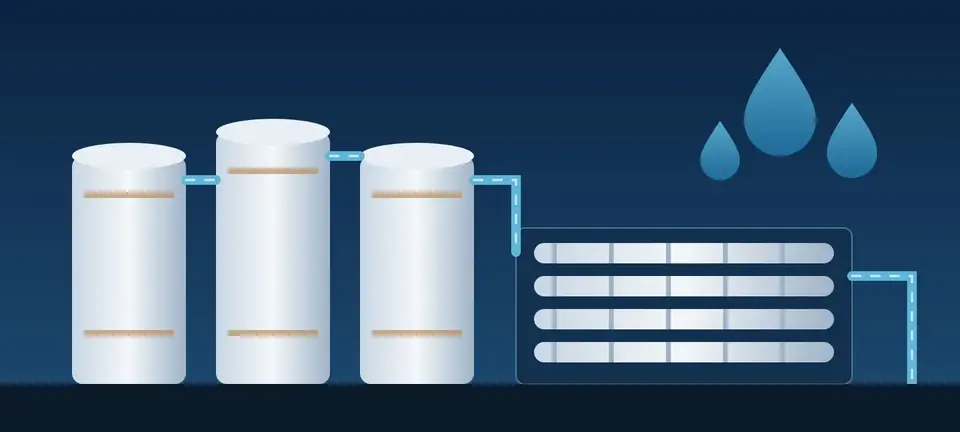
Every station is designed for its own feed water and quality target, but most purified water systems follow a similar sequence:
- Raw water tank and booster pump, sized to keep the system supplied at its design flow.
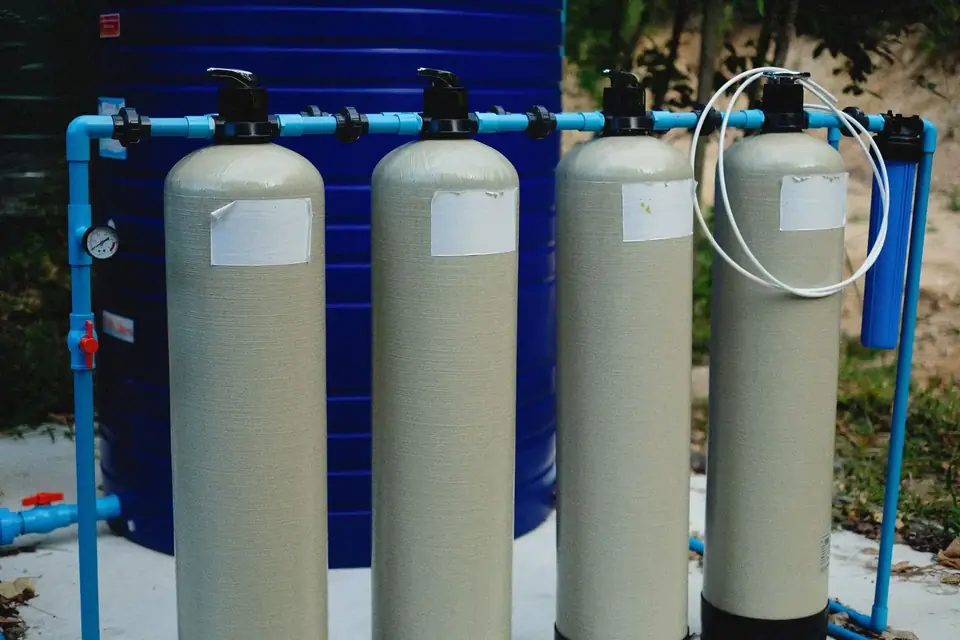
- Multimedia filtration to remove suspended solids and turbidity.
- Activated carbon or dechlorination dosing to remove chlorine, which would damage reverse osmosis membranes.
- Softening or antiscalant dosing to protect the membranes from scale.
- Cartridge filtration as the last guard before the high-pressure pump.
- Reverse osmosis (RO), single or double pass, which removes most dissolved salts, organics and microorganisms.
- Polishing, such as electrodeionisation (EDI), where the conductivity target requires it.
- Ultraviolet (UV) treatment to control microbial growth before storage and within the loop.
Design the storage and distribution loop
Many water quality problems start after the treatment train, in tanks and pipes where water stands still. Good practice for storage and distribution includes:
- Sanitary stainless steel tanks and pipework, commonly 316L, with smooth internal finishes and sanitary connections.
- A continuously recirculating loop that returns to the tank, sized to keep the flow turbulent.
- Minimal dead legs at points of use, and lines sloped so the system can be drained.
- A hydrophobic vent filter on the storage tank.
- Online monitoring of conductivity and, where required, total organic carbon, with alarms.
- Sampling valves at the generation outlet, the loop return and every point of use.
- A sanitisation method designed in from the start, such as hot water, ozone or chemical sanitisation.
Qualification and validation
In a GMP plant the water system is a critical utility and must be qualified before production water is released. The usual sequence is design qualification (DQ), installation qualification (IQ), operational qualification (OQ) and performance qualification (PQ), including an intensive sampling period defined in your validation plan. Allow time for this in the project schedule, and keep documents such as material certificates, weld records, P&IDs and calibration certificates from day one. Involve your quality assurance team from the start: they approve the protocols and decide when the water can be released for production.
After release, routine monitoring, trend analysis, sanitisation and preventive maintenance keep the system in a validated state. Any change to the system should go through your change control procedure.
How MarkSphinx helps
MarkSphinx designs and builds water treatment and purified water stations as part of our solar, energy and water services, and coordinates them with MEP design for production facilities.
- Supply and installation of a purified water station and distribution network for CIRA Cosmetics in Cairo.
- Reverse osmosis, filtration and booster pump systems, and water and wastewater treatment.
- MEP design and supervision for ADCO Pharmaceutical Factory, MEP design for ADWIA, and HVAC and fire fighting design with execution supervision for Rameda.
- Clean rooms for pharmaceutical production as part of our special HVAC applications.
Water rooms also need the right cooling and power; see choosing VRV/VRF or chillers and why factories measure earthing.
Frequently asked questions
Not necessarily. Reverse osmosis is one treatment step. Purified water is defined by the specification it must meet, such as a pharmacopoeia monograph, and by how it is stored, distributed, monitored and validated.
Not always. Cosmetics plants follow cosmetics GMP and their product specifications, which may be less demanding than a pharmacopoeia monograph, although many use similar RO-based systems. Define the required quality first, then size the system to it.
Sanitary stainless steel, commonly 316L, is widely used for pharmaceutical loops. Some lower-risk applications use suitable plastic piping. The choice depends on the quality target, the sanitisation method and the validation approach.
Often, yes. A survey of the current system, the feed water and the monitoring data shows whether adding steps such as softening, a second RO pass, EDI, UV or loop modifications can reach the new target.
This article is general technical guidance, not legal or regulatory advice. Requirements depend on the building type, its use and the current rules of the relevant authority, so confirm them with the authority or a qualified consultant before you act.